
Share the page
Understanding research at AFD
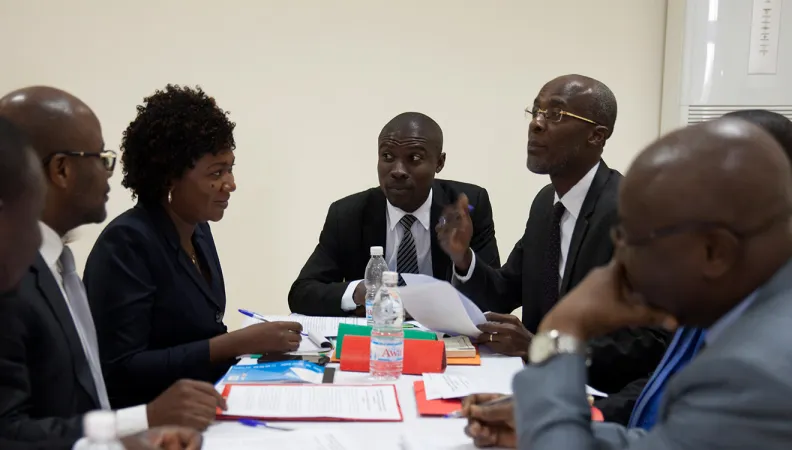
Climate change, biodiversity, inequality – our research contributes to analyzing the major global challenges we face today. Because anticipating and understanding better means acting more effectively. Structured around five priority research areas, AFD’s research places public policy dialogue and research partnerships in the South at its core.
Why does AFD conduct research?
As an integral part of France’s sustainable and solidarity-based investment policy, AFD’s research aims to support developing countries in their economic, ecological, and social transitions. It complements AFD Group’s financing operations by offering strategic insight and analytical depth.
Co-developed and carried out with partners in the countries and regions where the Group operates, this research seeks to closely examine the links between global climate challenges and financial and social systems.
In a fast-changing environment, research plays a key role in helping the Group understand and anticipate socioeconomic shifts in partner countries. It also helps identify and manage risks in complex and evolving contexts. More broadly, it informs operational teams, guides intervention strategies, and ultimately aims to enhance the impact of funded projects.
What is our approach?
Inspired by a think-and-do tank approach, our applied research is conducted by multidisciplinary teams in collaboration with academic partners from both the South and North. The goal? To co-design sustainable development pathways with our partners and identify the most context-appropriate public policies to achieve them.
Our research lies at the intersection of multiple disciplines: economics, environmental science, sociology, demography, anthropology, political science, and more. It aligns with the principles of sustainability science, which calls for mobilising all disciplines to transform development models toward greater sustainability. As such, our work is rooted in a strong sustainability approach.
On what do we focus on?
AFD Group’s research and study strategy aligns with the priorities of the Group's strategy. Our work is structured around five key research priorities, reflecting an original and innovative positioning:
Who finances development, how, and for what purpose? At a time when geopolitical balances are undergoing profound change, this research program explores the transformations shaping international development finance – actors, strategies, instruments and governance – to inform the strategic choices of donors and partner countries.
Through country risk monitoring and the modeling of countries' macro-financial trajectories, this program produces analyses that are useful to AFD Group and to public decision-makers in partner countries, informing choices on the definition, financing, and implementation of sustainable development trajectories.
This AFD research program analyzes and models the various effects of climate change and biodiversity loss. It also examines how these dynamics interact to reshape societies, ecosystems, and economies. The goal: to provide analysis and the tools needed to accelerate the ecological transition while improving people’s well-being.
This research program examines the conditions under which public and private sector investments — in value chains, infrastructure, and more — can become genuine levers for reducing inequality and improving living conditions for the most vulnerable populations. The goal: to provide tools and analyses to help ensure that every investment effectively contributes to reducing inequality, from project design through to evaluation.
As socio-political crises and the polarization of societies intensify, how can social ties be rebuilt and shared resources managed collectively? This research program explores the emergence of alternative modes of governance and citizen participation, particularly through the commons. The goal: to build a better understanding of the social dynamics at work, in order to respond to people's aspirations and support initiatives led by citizens.
How do we conduct our research?
AFD Group’s research operates at the intersection of academia and policymaking, with the goal of informing public policy dialogue. It places a strong emphasis on collaborative research, particularly by supporting and involving researchers from the South.
In countries with which France maintains close ties, AFD engages in strategic dialogue on public policies, enriched by research findings. This new form of partnership fosters spaces for interaction and debate between the academic world and decision-makers to help shape public policy.
Through this approach, AFD funds research activities on topics of interest identified by partner country authorities, where AFD holds proven expertise. Research outcomes are discussed at the ministerial level and shared with civil society.
Beyond these contexts, broader policy dialogues around sustainable development pathways and the interplay between environmental and social challenges—with an emphasis on a just transition—are also supported in various AFD partner countries, such as South Africa, Colombia, Mexico, Indonesia, Vietnam, and Uzbekistan.
AFD pays particular attention to promoting research in Francophone African countries, which often lack strong connections to international research networks. However, AFD remains open to supporting research across all its partner countries, including Anglophone and Spanish-speaking regions.
To encourage co-creation of solutions and knowledge sharing, AFD fosters collaborations with a wide range of research partners in its areas of operation: research centers, universities, think tanks, national statistical institutes, and regional or continental institutions.
AFD also relies on the research partnerships network of French institutions active in its countries of operation—such as IRD, Cirad, and the UMIFRE network—to maximize synergies. It collaborates with international institutions engaged in research and innovation on development policies, including national and multilateral development banks, the European Union, universities, research institutes, and think tanks.
Finally, AFD develops partnerships with French research laboratories through the CIFRE scheme, which allows selected PhD candidates to conduct their doctoral research while being hosted within AFD.
Our researchers

What does our research lead to?
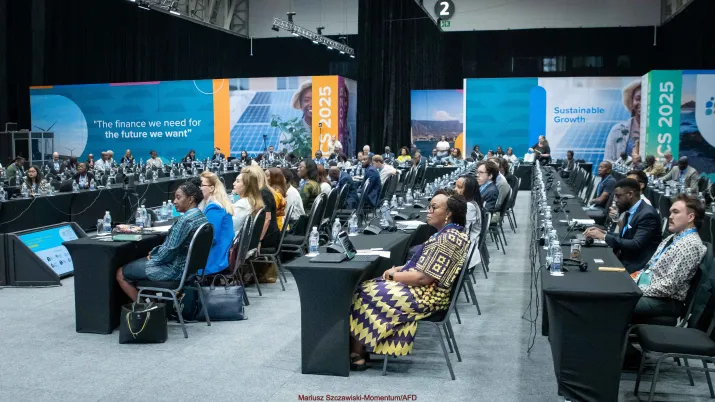
Our research work results in studies and analyses, as well as tools that inform evidence-based public policy dialogues. These findings also feed into a series of conferences that provide platforms to discuss the issues addressed.
How can we think about development pathways without studying the impact of ecological disruptions and their interactions with financial and monetary risks? To provide solid insights and to support political decision-making in line with the Paris Agreement (COP21), AFD has, for several years, been developing macroeconomic modeling tools:
- The GEMMES macroeconomic model assesses the socio-economic impacts of climate change and adaptation strategies to address them. Several country-specific versions of GEMMES are developed in partnership with local stakeholders in Brazil, Colombia, Côte d’Ivoire, Morocco, Tunisia, Vietnam, and others.
- The ESTEEM model analyzes the macro-structural vulnerabilities that a low-carbon transition may generate in developing countries. It evaluates dependence on declining industries through three dimensions: external, fiscal, and socio-economic.
Additional tools provide insights into ecological transition dynamics:
- The ESGAP indicator assesses the environmental sustainability of a territory by measuring the gap between the current state across 23 environmental dimensions and the desired thresholds.
- Research on climate financial risks, conducted in partnership with WTW, evaluates the financial risks that may arise as countries transition toward low-carbon economies.
AFD also develops tools to better understand inequality dynamics, such as:
- An inequality diagnostic tool that provides an in-depth analysis of various types of inequalities in a given country, helping to identify key priorities and policy options to reduce them.
- Fiscal incidence analyses, which assess the impact of taxation on inequality and poverty – guiding the development of well-designed redistributive tax policies that protect poor and vulnerable households.
AFD’s research outcomes are published in academic journals and as in-house publications, notably through the Éditions Agence française de développement. These publications aim to:
- Share the expertise of our researchers
- Contribute to the global development debate
- Inform strategic public policy dialogues
Over 1,300 open-access publications are available on our website.
Beyond publications, research findings are shared through events that foster dialogue between decision-makers, practitioners, and academics:
- "Research Conversations": A bi-monthly webinar series featuring recent AFD-funded studies, offering insights to a broad French- and English-speaking audience.
- AFD International Research Conferences: These conferences address innovative research topics that yield actionable policy recommendations, such as:
Commons and Development (2016)
Inequality and Social Cohesion (2018)
The Visible Hand: Development Banks in Transition (2020)
Strong Sustainability: Are Net Zero Development Pathways Sustainable? (2022)
From Research to Action: Putting Results at the Service of Public Policy (2024)
- Perspectives Outre-mer: Formerly AFD-CEROM, this annual conference focuses on the French Overseas Territories. The 2025 edition explored: “Oceans in Common: Overseas Territories and their Regional Basins”

Our research projects

Our upcoming events
How – and how far – can we still adapt? Knowledge and societies responding to the challenges of adaptation
Join us for the 17th AFD International Research Conference on Development.
Paris 75012